Inception
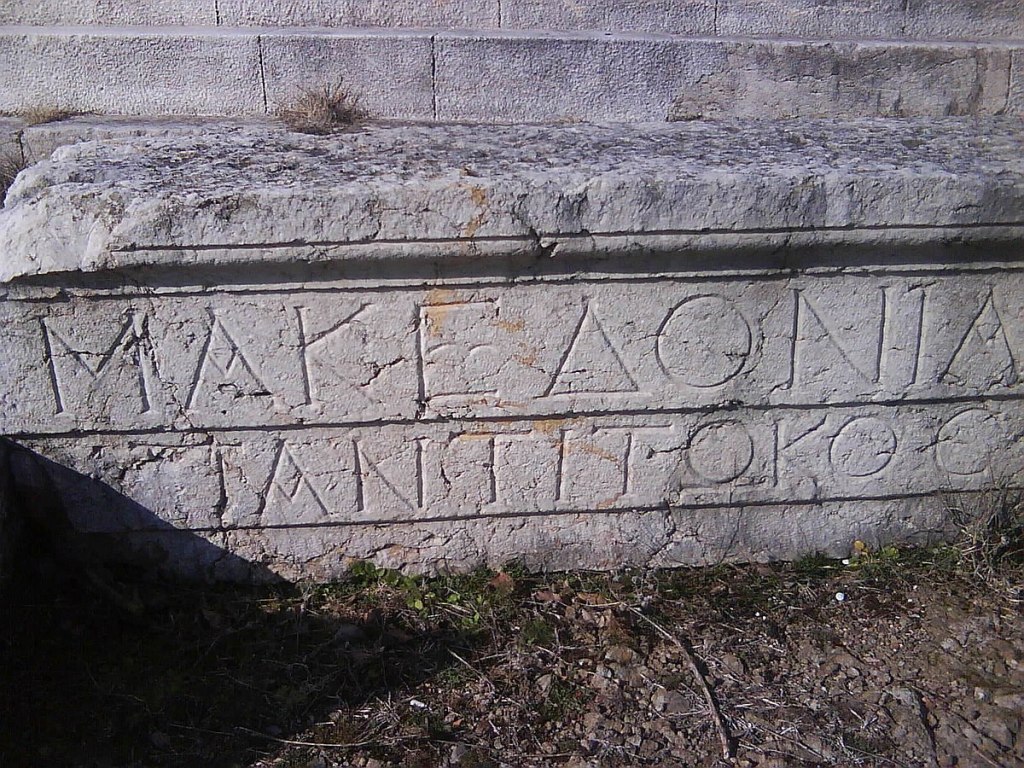
There are many versions as to how the name “Macedonia” came to be. The general consensus is that it is of “Greek” origin; but if you ask a Greek what it means, they have no idea. Neither did the so-called Ancient Greeks, and they gave their own interpretations. The linguists have all agreed that it comes from the Homeric word “makednes”, which they take to mean, “tall poplar”, hence making Macedonia, “the land of the tall ones”.
Now, one might think, that’s fine and all, I mean, we are tall people after all, but this interpretation is missing the point – and the point is that the name a carries a much deeper meaning, one that goes to the annals of prehistory, and that is hidden within the language itself.
The Macedonian language, in its raw, original form, is a syllabic language. As such, its syllables – each carrying a meaning of its own – can be combined to give rise to a completely new construct. In other words, the meanings of the syllables come together in order to create one, larger meaning. This is the purest form of language, as it resembles the speech of babes when they first begin to utter words – called nursery talk, or infantile reduplication. That the ancient Macedonian language was syllabic can be attested through the middle script of the Rosetta stone, as deciphered by our late linguist, Dr. Aristotel Tentov and academician Tome Boshevski. They deciphered it with the help of the Macedonian language, because they rightly worked on the premise that the text is written in Ancient Macedonian, and under the assumption that the language has largely been unchanged, meaning, that the Macedonian language of today is the same as the one spoken in Alexander’s time.
Thus, they were able to deduce 8 vowels, which, depending on the rotation give 27 consonants. The sounding of the vowels, consonants and ligatures discovered therein was based on archaisms found in the dialects of the modern Macedonian language, and the results were stunning. No less than two hundred words were discovered that correspond directly to the words still in use in this dialects. Like other ancient languages, ancient Macedonian was read from right to left. That should suffice for now on the language, because examining is not within the scope of this article and shall be dealt with properly on another occasion.
Sad to say that this discovery is ignored by our academic institutions, who being ever the obedient servants, beholden to Western academia, shriek at the thought of admitting that Ancient Macedonian is indeed the ancient form of the language we speak today. That is why they dismiss this find as “unscientific”, “quasi-historical” and so forth, oh and let us not forget “nationalistic”, which is also the rhetoric of the Western and thus international institutions. For this reason, it is up to independent researchers, Macedonicists, to continue the good work of Dr. Tentov and Dr. Boshevski. However, without proper support and backing the work is going slow, because these individuals are left on their own, and as such cannot even afford proper access to the Rosetta Stone, which is stowed away at the British Museum. Nevertheless, their relentless effort has borne fruit.
The Great Mother Ma
On the stone we find the following sentence:
“АеДоМаНаЦеД = AeDoMaNaCeD” => Deca na Modea = Children of Modea, the goddess Mo/Ma, which gives rise to another Macedonian word, “moma”, “girl.”
Alternatively we can find, “oMaЦеД = oMaCeD” => Deca Mo, same meaning, “Children of Mo.”
So, here, we can see plainly laid out the name of the goddess Ma, that is the Mother Goddess. Many cultures in the world have had a cult centred around a Great Mother Goddess. In prehistoric times, societies were matriarchal, and the woman as a life giver was highly honoured. The Balkan peninsula was no exception. The Great Mother is a Balkan deity par-excellence and she has continued to be worshipped long into later history, though in more of a secondary role as societies shifted towards patriarchism. Countless statuettes of the Great Mother have been found on the soil of the Balkans, and in the case of Macedonia a unique form of her as if emerging from a house has been discovered. The other place where Ma is found is in present day Cappadocia, the once homeland of the Hittites and the Phrygians, though here we find the goddess in a warlike manner, wielding an axe and wearing armour – and also having a halo of sun rays around her head – another symbol which shows the ancient reverence of the Macedonians towards the sun. Ma is an original, autochthonous deity of the Brygians, a tribe that made up the core nucleus of Macedonian entity – even Alexander himself hailed from this tribe.
This reveals to us that her cult was brought over in Asia Minor by the Brygians, who after resettling became known as the Phrygians, and then she was later appropriated by the Hittites, kindred people who spoke an “Indo-European”, id est Proto-Slavic/Macedonic language. Despite however becoming a goddess of war in the Bronze Age, Ma survived as a Great Mother goddess of the earth in the form of the Phrygian Semele, that is Zemela, in other words zemja/zemlja, “zемја/земља”, “ground, earth”, also known as Cybelle. Meanwhile, no such statutes – whether in her primordial form, or as the warlike protectress – have been found in mainland Greece, which proves to us once again that this deity is purely Macedonian. Mo/Ma, then is the oldest name ever attested of this goddess, perhaps used even in the time before its first attestation, since Ma survives in the nursery term “mama.”
The Children of Ma
This linguistic code for the mother is thus preserved in the name Macedonia, and even in its earlier forms. The oldest form of the name is Emathia, as attested by Herodotus. Macedonian historian, Dr. Nade Proeva posits that the name comes from the Hellenic word for “muddy sand/soil”, “mati”, having named the land as such after arriving on its sandy shores via ship. However, that cannot be as we shall soon see.
Emathia contains the word for mother in it, and that is “mati”. This word, in such form is preserved to this in Serbo-Croatian, but can also be found in the Baltic languages, a language family closely related to the Slavic, id est Macedonic, and thus properly called Balto-Slavic.
“E” here represents an appellation, thus giving us the phrase “E mathia!” = “oh, mother.” In modern Macedonian that would be “е, мајко!”
Later on we have another given name, Maketa. We can plainly see that this version also contains the root word, “Ma”. Interestingly enough, this word survives today in the Macedonian language in that exact form, and it means “blueprint.” In this light, Maketa would be the land where it all began, the blueprint in a sense for future developments, rightly so the birthplace of the Macedonians.
Now finally we reach the famed name of Macedonia, and that of the Kingdom of Macedon; Македонија and Македон, in Macedonian respectively. According to legend, Macedon and the Macedonians got their name from the eponymous god Macedon, of whose birth there are various given accounts. The most famous and widely accepted is that he is the son of Zeus and Thyia.
Even if we take this to be so, again we can see the same pattern repeated in the name of Macedon himself. His name also carries the code of the mother, MAcedon. If we break down his name in syllables it gives us:
Ma + Ked + Оn = > Ма Чедо Он, Ma Child He = Он е чедо на Ма/ On e chedo na Ma = > He is a child of Ma.
Now someone might protest and say, wasn’t his mother Thiya? Well, yes, but we need to remember that the Olympians are the children of Chronos and Rea, themselves born from Uranus and Gaia. Gaia is simply a later rendition of Ma, the Goddess Mother, and even in this form her name carries the code of the mother, that is her role as a nurturer. Namely, Gaia comes from the Macedonian word “гаи/гои”, “gai/goi” because the earth – the Great Mother is a personification of the earth – is nurturing us with her produce, but also the mother as a parent is doing the same with her milk.
Thus we can see that the later Olympian pantheon is not Greek but Macedonian, representing a later manifestation of earlier beliefs, from the Neolithic, continued through the Pelasgian substratum – a claim further consolidated by the fact that the cult of the Mother Goddess is not attested on the soil of Hellas in prehistoric times. What this tells us is that the Macedonians continued the worship of the Mother Goddess under various iterations, down to the appearance of the kingdom of Macedon, and they’ve honoured her through their name.
Thus, we cycle back to the sentence of the Rosetta Stone:
“Deca na Modea”, and hence we get Македонија = Ма + кедо/чедо + ниа = чеда на Ма ние => Ma-kedo-nia/ Ma chedo nie = nie decata na Ma = We, The Children of Ma.
Makedonec – not Makedones
At this point the Homeric “makednes” , rendered in koine as “μακεδνῆς” must be mentioned. If we consider for a moment that Homer was not Greek, but Macedonian, and that he wrote in a Macedonian dialect, and not Greek – some 400 and plus Macedonian words still in use today were found in his works – we get another picture of the meaning of the word. If we consider the letter “sigma”, “ς”, to be the same as the Latin, “c”, but read as the Macedonian “ц”, “ts”, since the letter in the Latin alphabet is transcribed with “c”, then we arrive at “makednec”, id est, “makedonec” – the same adjectival from that we use today “Македонец.” So Homer here is simply referring to the Macedonian, the child of Ma. But, since he himself does not give any explanation to it, later scholars have taken upon themselves to interpret it as “the tall ones.”
Even the word that Dr. Proeva proposes, “mati” is not Greek but a pure Macedonian word still in use today. Namely, “mati”, “мати”, means “to stir” in Macedonian, but also it can be taken to mean “muddled”, “zamateno/matno”, “заматено/матно” in Macedonian, in this case a “muddy/muddled land.” It would be better to suppose that these alleged Hellenic sailors that reached the shores of Macedonia, at the time Emathia, got the name from the locals themselves.
The truth is one cannot be denied, and the language itself is the key to this truth. It is a hidden code that requires understanding of these things in order to be used. That is why the name cannot be Greek, in any of its forms. The Greek gave their own interpretations because they did not understand our language, and that is also why they gave interpretations to the names of the deities that they appropriated much later.
There is much to be said on this topic, but more on that in another article.
 Rebus Macedonicorum
Leave a comment