Introduction
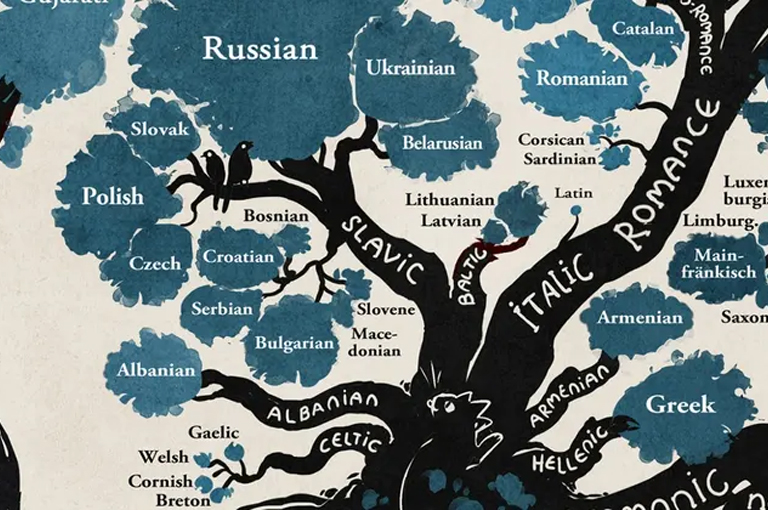
The Macedonian language that we speak today, is neatly grouped in the South-Slavic group of languages, a branch which hangs from the larger family tree of Slavic languages. Other languages from this group are Serbian, Bulgarian, Slovenian and Croatian. I will not include Montenegrin and Bosnian, because these are not languages but dialects of Serbian – whether anyone likes it or not, it is the truth.
Now, at first glance this seems rather okay, but we need to remember that this is how the official science groups these languages. What does the official science then say about the language of the Ancient Macedonians? This is a hotly debated topic within the academic community, and it is a large conundrum with which scholars cannot come to grips with. Opinions are divided between it being:
- A northern dialect of Greek.
- A language in its own right, but not related to the “Slavic” Macedonian of today.
Those that argue that the Ancient Macedonians are Greeks, favour the first theory, while others who think that they are their own people, favour the other. But they are both wrong – well the second is only half correct, and that is because while it is true that the language is unique in its own right, it is not true that it is not related to the modern, so called “Slavic” Macedonian.
For truth’s sake, it must be mentioned that not much is available to us when it comes to direct written material by native Macedonians, but that doesn’t mean we don’t have any material to work with. In fact, the material is quite abundant, if one would simply have an open mind to it. Sad to say, our academic institutions are very closeminded to it and cling to the official narrative like a baby to its mother. In my previous post on the name of Macedonia, I briefly brushed upon the discovery of Drs. Tentov and Boshevski of the Ancient Macedonian language being written on the Rosetta Stone, and that being the middle script. In a paper titled, “Tracing the Script of the Ancient Macedonians”, they claim that the language is the same as the one we speak today; this is undeniably true and I will prove that it is so.
But first, let’s get rid of the proverbial elephant in the room, and that is the “Slavic” nature of the language. So, the main theory goes that Macedonian, like the other Slavic languages is an Indo-European language that makes its first debut on European soil with the mass migration of the Slavs from the Russian steppes. The invading Slavs flood over Europe, descending from behind the Carpathian mountains, and displace both the previous population of Europe, and their language. They decimate the poor Greeks in the Balkans and they take their place as the new inhabitants. Or so the official story goes, but that is a load of hogwash. Now, I will not discuss on the Slavs and their alleged migration – that is a topic for another post – but I will instead focus on the language, as is the topic of this post. This was just a slight preview of how things stand.
First of all, this Indo-European nonsense is well, quite rightly so – nonsense. Why? Because the mother tongue didn’t originate in India, and then allegedly being spread over to Europe, as the name suggests, and most certainly has nothing to do with India, except the Sanskrit which in origin is not Indian at all.
On top of this, today we even have the more ludicrous theory of Proto-Indo-European. This language is a linguistic construct, an attempt to recreate the so-called Indo-European mother tongue of prehistory. Alas, seldom do the interpretations make any sense and in other cases they border on the paranormal. Now, this will surely sound radical, but the real, the true European mother tongue is the Pelasgian speech, of which Macedonian is its most direct descendant. If we want to sound politically correct, we might say that the language should be called “Euroindian”, because it originated in Europe and then migrated outwards. Now who exactly were the Pelasgians we will discus in another post, but what matters is that Macedonian has preserved that speech the most. But before we get into that, we must prove that the Macedonian of ancient times, is relatively the same one, as the one of today.
Rosetta Stone Examples: Gyuptin
In my previous post I demonstrated how the proof of the name Macedonia as related to the goddess Ma can be found on the Rosetta stone. We also saw the word “deca”, meaning “children”, and this word is still in use in Macedonian today. Following this example, we can discover many other words. Thus, in the script we find the following sentence, transcribed in modern, Macedonian script:
еВаЦаПọуЃ аН ẹЗНаН НеВẹЗаН оМ ьJ = Jь Mo НаЗẹВеН НаНЗẹ На ЃуьПаЦаВе = jь mo nazeven nanze na gjuopatsave.
The English equivalent is, “ I am the necklace of necklaces of the Upper Egyptians”. In modern Macedonian this would be slightly different:
“Јас сум наречен/назван најѕе на ѓупциве” = “jas sum narechen/nazvan najdze na gjupcive.”
Najdze means the highest, since Dze is the name of the high god, but more on him another time. To make it clear who this sentence refers to, it is Ptolemy Eucharist the Macedonian pharaoh of Egypt, from the Ptolemaic dynasty. Now this sentence is very interesting because it contains the word “gjupatsave”, a word commonly used in Macedonian today.
What does this word mean today? It is used to denote a person belonging to the – brace yourselves – Egyptian minority that lives in Macedonia today. That is correct, in present day Macedonia there is a community of Egyptians that have been present here since the times of Alexander, possibly even before. “Gjupatsave” is a plural demonstrative form of the noun. The singular form would be, “gjuoptas”, which is also used in the same manner today, “ѓупац”, “gyupac.”
So the word “ѓуптин” , “gyuptin” , virtually unchanged in its make, today is used to refer to the same people whom it referred to thousands of years ago. Even more interesting is that we can find it in the dialectal form, “еѓуптин”, “egjyuptin” – identical to the English, Egyptian. So, the English, Egypt, borrowed from the Latin Aegyptus, comes from the Ancient Macedonian “аПьЃ”, “GyuPa” , which was the name of Upper Egypt proper, hence Gyuptin. Lower Egypt on the other hand was known as “ЃьЗе”, “gjьze.”
Naturally, from this the question arises, how on Earth could an Ancient Macedonian word find its way in the language of the migrant Slavs, and in its identical form? It cannot be, unless the language was spoken by the same people and the same way, uninterruptedly. In the other Slavic languages this word is absent, which proves that the word was lost as the language travelled northwards, but it was kept in Macedonian which stayed close to the core. This is one of the many examples.
Adored by the Gods
Let’s explore a bit more. In the text, we can also find the nickname of the Pharaoh, “Epiphany”, rendered as:
ИејеВиД оМоГоБ ьЈоТ = IejeViD oMoGoB JoT = Toj Bogomo Divejeii.
Transcribed in modern Macedonian this would sound like
“Tој кој што боговите му се диват”, “Toj koj shto bogovite mu se divat” = “He whom the Gods adore.”
Let’s unpack this carefully:
We have, “toj” and “bog” which are in the same form and use today, and also diven. Diven, is mostly preserved in Serbian today as “диван”, as well as the verb “дивити” , “to admire/adore”, though the adjective does survive in some dialects of Macedonian. This word is a linguistic cognate to the Latin, “divus”, “divine”, but also to “deus”, “god”. Again, this word does not exist in other Slavic languages like Russian, which once again proves that it is not a carryover.
That this sentence is correct, the authors prove by referring to the “Greek” equivalent in the third, lower text, written as “ΔΕΟΥ ΕΠΙΦΑΝΟΥΣ”, “Deoy Epifanoys”.
Written in Stone
Now, I will give one final example, which is very telling, before moving on to other sources. In the second order of the pharaoh, where it is decreed how and where his decrees shall be written, we find the order given for it to be set in stone. In Ancient Macedonian it’s rendered as following:
ЈьВи БьДе На Ши НаВеЗеНе, jьvi bьde na shi navezene = Let it be written in stone.
Transcribed in modern Macedonian this would read:
„Ова да биде на камен навезено”= “Ova da bide na kamen navezeno.”
Most of import here for us is the term, “navezeno”. That is because in modern Macedonian parlance, navezeno refers to the mode of writing of someone, especially when they write very neatly. In this case we use the term, “тој везе„ , “toj veze” , which literally means, “he is embroidering”, because the fine writing is taken to be synonymous to how one is embroidering fine things carefully and elegantly. Once again, this is a pure Macedonian word which cannot be found in the other languages. Instead, for the same action, Russian for example, uses, “Vyshityy” and Czech to give another example, uses, “vyshivany”, which corresponds to the Macedonian, “вшиено”, “Vshieno”, but this is used for “sewn” and not “embroidered”.
Hesychian Lexicon
Now as promised, let’s have a look at something else. The Rosetta Stone is not the only source for Ancient Macedonian. Other such source is the grammarian Hesychius of Alexandria who was a native Macedonian and who wrote a comprehensive dictionary of Macedonian words, now sadly lost. Nevertheless, some glosses survive in other works of later times. Here are some words who correspond to modern Macedonian words in their entirety.
Peripeteia = Перипетија. In Ancient Macedonian this was a word denoting a festival. In modern Macedonian it has lost its original sense, and instead it’s used to mean an unfortunate turn of events.
Kunopes = Кунопес. This is said to mean, “dog faced”, and in it we can see two distinct Macedonian words, namely „пес“ and „куна“, “pes”, “kuna”. Pes is a synonym for “kuche”, “dog”, while “kuna” means “marten”. Both animals are “dog faced”. Interestingly enough, we can also spot the root “ku” found in “kuche” – a word which does not exist in other Slavic languages. Instead, variations of the word “pes” is used. The root “ku” can also be found in the Gaelic word for “dog” , “ku”, as in the name of the famous Celtic mythical hero, Cu Chulain, “The Hound of Chulain”, which opens up another, Celto-Macedonian connection about which I will speak of in another post.
Gadara = Гадара, which is a compound of “ga”, + “dara” meaning “gifts him”. In modern Macedonian, “го дарува„, “go daruva”. The “Slavic” word “dar” we can also find in the name of the ancient Macedonian god of healing, Daron. Daron, Дарон, is another compound, “Dar + on”, and it means “He gift”, in a sense that he gifts health to the people.
And to wrap up this post, here is another compound word which for the countless times shows that the “Macedonianness” of a word can be inferred from seemingly non-Macedonian words by simply breaking that word down in syllables.
Leibetron, is a word that in its simple terms means, “spring”. But once we break it down, it reveals something deeper and this proves the Macedonian ingenuity of encoding various abstract meanings into a single word. Thus, broken down it gives us:
Lei + b(v)etron = лејветрон. “Ley” is a Macedonian word which means “to pour”. Now if we take into consideration that the “Greek”, “beta”, is actually “vita”, and thus transcribed into Macedonian as “v”, then we get “vetron”; “Vetron” is a demonstrative form of the noun, “vetar”, “wind”. The “-on” suffix here, is used to refer to a thing which is not in our immediate vicinity. Thus all combined gives us, “that wind is pouring”, and this is a metaphorical description of the flow of the spring, as if being carried on by the wind.
Some Concluding Words
These are just a few words from which can infer some meaning, however we must admit that it’s impossible to know the meaning of every word. Not one language has remained completely unchanged since its formation, so we can’t demand a hundred percent alignment. The words offered by the lexicon, and also found elsewhere, must be rigorously studied and examined, like the examples given here. But as long as our institutions refuse to accept the reality, that the modern Macedonian is the descendant of the Macedonian spoken in antiquity, we might not get too far. The least one can do, like myself, is use logic and deduction to infer sound meanings that make sense. With that in mind, I will be seeing you all in the following post about the language.
 Rebus Macedonicorum
Leave a comment