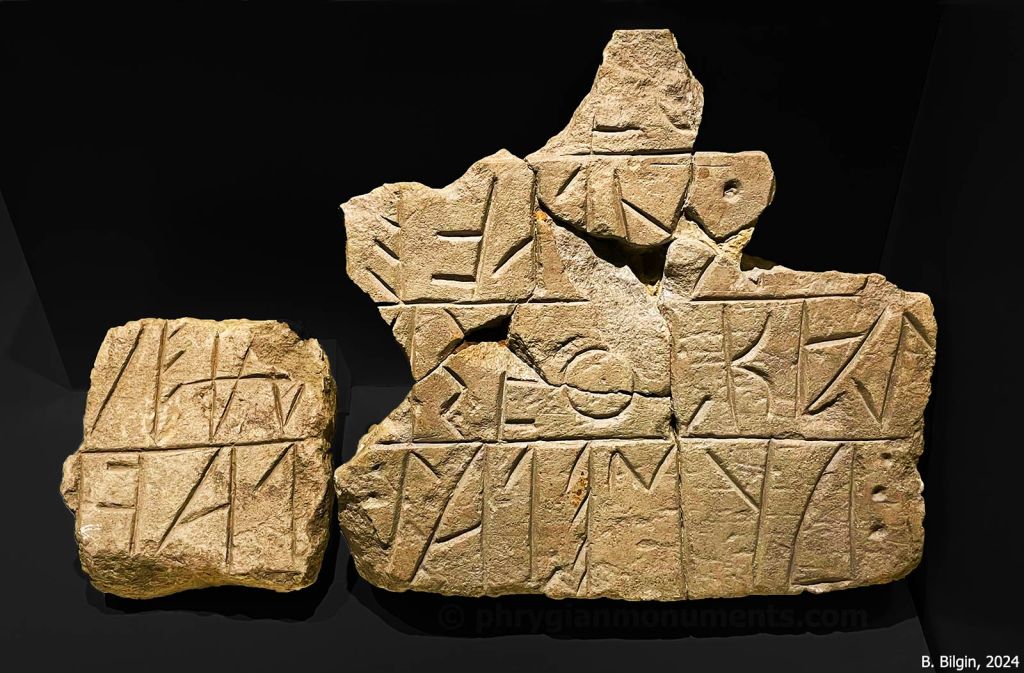
Phrygian, That Is Brygian
In part I of this short post series, we had a look at excerpts from the Rosetta Stone, as well as some glosses from Hesychius’ lexicon, but there is so much more to be said and to be explored about the Macedonian language. In part II we will look further into the antiquity of this language, and its connection to other, ancient languages.
Macedonian is naturally close to Phrygian, since the Phrygians are an Ancient Macedonian tribe that settled in Asia Minor around 1200 BC, shortly before the fall of Troy. In the Macedonian mainland they were called Brygians or Bryges. From the few Phrygian words that have been deciphered thus far we can offer the following:
Ezis(sh) = Ezhish = to prickle, hence the word for hedgehog, “еже„, “ezhe”.
Bere, “carry” in Phrygian = Бере, Bere = to gather, but also to “bear care” in a sense of having a care on one’s shoulders. Hence also the English word “bear.”
Knaika = Woman, in Macedonian became preserved as “Snayka”, which can mean either daughter-in-law, or sister-in-law, depending on context. This is just one example of the so-called process of “specialisation”, where the meaning of one word narrows down to a one, specific meaning.
Bagaios = can either mean “holy”, or” god” in Phrygian. In Macedonian it’s “bog”, but where the similarity really comes to the fore is with the dative form, “boga”, “na boga.” Hence also the Sanskrit, “bagavat”, “resplendently rich.”
Esti = the auxiliary verb “to be”, identical to the Old “Slavic”, “esti/jesti”. In modern Macedonian it became shortened to “e”. Hence also the Latin, “est”. It’s interesting to note that Macedonian and Latin have virtually identical forms of the verb “to be”, which we’ll glance at another time.
Tos/Tois = this is a third person masculine pronoun, “he”. In Macedonian the same form is preserved, minus the “-s”, “toj”.
Se/E = a demonstrative or definite article. Same form and function preserved in Modern Macedonian; “se/e”.
For example: “tie se ubavi”, “they are beautiful” ; “taa e ubava”, “she is beautiful.”
Matar = Mater/Majka = Mother. Identical, thought the standard form in Macedonian is “majka”.
Bratar = Brat = Brother.
Temenos = grave. The Macedonian word for the back of the head, “teme”, is most likely derived from this, since it looks like a mound of dirt.
This should be enough for illustration. After all, we don’t want to overburden the matter.
Hittite
Now, let’s have a look at an even more ancient language than Phrygian, and that is Hittite. The Hittites are the oldest attested Anatolian civilisation, contemporaries to the Assyrians and Babylonians. Since they used Cuneiform to write their language, it was long assumed that they were Semitic people like their contemporaries, but when the language was deciphered it was discovered that they were “Indo-Europeans” speaking an “Indo-European” language.
The Hittites called the Phrygians, who became their neighbours, “Mushki”. The “officials” struggle at the meaning of this word, they simply have no clue what exactly this word means, or to whom it referred. We can find this word in the modern, Serbian language, preserved in the same form, “mushki”, meaning “manly”. In Macedonian, the form is slightly different, “mashki”. Now the officials will tell us that this is purely a coincidence, that these words have nothing in common and that they developed independently – however, there are no such things as coincidences.
The matter of the fact is, the Hittites spoke a form of the same Pelasgian language that the Phrygians and Macedonians spoke, and they called the Phrygians manly because they were exceptional warriors. So that we won’t be accused of shortcomings, here are a few other words for illustration.
Watar = Voda = Water.
Siwat = Day, in Hittite. In Macedonian “day”, is “den”, but we find “siwat”, in “siya”. Siya/Siyae, Siyat in western dialects, means “it shines”; the literary form is “sveti”, which too has the same root as “siwat”. Siya perfectly encapsulates as to why the former refers to the day, because when it is day the sun is shining, it is bright outside – quite literally siwat/siyat.
Nekuzzi = Nokj = Night. The plural Macedonian form “nokji” looks even closer to the Hittite.
Ed/Ad = Jade = Eat. Perfect match; hence also the Latin, “edo”.
Newa = Nova = New. The Hittite and the Macedonian feminine form of “new” fit word for word.
Da = Daj/Dava = Give. The Latin “dono” stems from here.
Now last but not least, and perhaps the most intriguing of all is the word for “man/person.”
In Hittite the word is as follows: “antusha”. At first glance it has nothing to do with the standard Macedonian word for “man/person”, “chovek”; we also have “osoba”, “lichnost” etc … But then we come to the realisation that we have the word “dusha”, which by itself means “soul.”
What makes this interesting is the fact in Macedonian “dusha” is also used to refer to a “person”. For example we have the sentence, “pet dushi”, “five people”, or , “edna dusha”, “one person.”
Following this logic, we can break down the Hittite word in two parts which would give us:
“An + tusha” , through the Interpetatio Macedonica we get, “on + dusha” = “he soul”; a perfect match to the Macedonian meaning.
Esoteric Linguistic Code
Officially, this word is taken to comprise of “ante” and “atusha” with the meaning of “facing forward/upward”, but this explanation – like any other official for that matter – is lacking in substance.
What this connection actually portrays, is a beautiful example of an esoteric code; the one with soul, “dusha” is the one who lives, who breathes, that’s why we have “dishi” for breathing, and then “duh” for “spirit” – all are linguistic cognates. The same principle can also be found in Latin. The word for “soul” in Latin is “spiritus”, but it also means “breath”; it can also mean a ghost. Now the “ghost” is basically the soul of the person after it leaves the body postmortem, but it lingers in the world without passing on – and that is why it is called “ghost”, because it comes from “guest”, and “guest” in Macedonian is “gost”. The ghost of a person is literally a guest on this world, since a guest is someone who comes for a visit temporarily, meaning they are not meant to stay for a prolonged period of time, same as the ghost. We have the same code in German as well, where gast (guest) = geist (ghost). In a sense we can also say that our souls are temporary visitors on this world, meant to exist eternally in the afterlife.
A slight digression here but I simply had to point out to these hidden esoteric codes found in language, which by the way perfectly explain the meaning of words and why certain things are called the way they are. Whether one believes in esoterism, or not is irrelevant; it is quite apparent that it can interpret words in ways official etymology can only dream off. Etymology only gives us the origin, but it cannot explain the essence of words; and Macedonian is such a language that can decode this deeper essence of the words. So, you can consider this as a slight prelude to what is to come down the line.
Lycian and Luwian
Now going back to our comparative linguistics, we’ll have a look at some other Anatolian languages, closely related to Hittie. These are Lycian and Luwian. Luwian was spoken circa 1500-700 BC, while Lycian is slightly younger being only spoken from 500-300 BC. Not many words are known so we can’t draw many parallels; nevertheless here are a few most striking examples, that are almost exact word by word.
Lycian:
Mala = Mala = Small. Same form, same meaning. The Macedonian is in the feminine form (another case of specialisation).
Aren = Aren = good. Still in use in colloquial Macedonian to this day. There is a slight difference to the meaning; whereas “aren” in Lycian can also mean “sacred”, Macedonian on the other hand has only kept the meaning of “good”.
Luwian/Hittite:
Zana/Zana-na = Zhena/Zhenana. Both mean “woman”; the Macedonian “zhenana” is a demonstrative form meaning “that woman over there”. The only real difference here us that the Lycian can also be used as a term for “goddess”, while Macedonian has only kept the meaning of “woman”.
Tarh/Taru = to conquer. We have the exact same root of this word in the Macedonian word, “tarashkuva”. It means “to command”. Though the semantical meaning is not the same, the idea behind it remains the same – both refer to some form of exertion of power.
Since the Anatolian branch broke off quite early from the Pelasgian substratum, the languages took a different route developing, than those that stayed closely to the core. That’s why most of the words differ, but a good portion of them seem to have stayed relatively the same. We find confirmation that these belonged to that same substratum in Herodotus, who says that the Pelasgians lived in Asia Minor too. When he enumerates the tribes fighting on Troys’ side in the Iliad, Homer mentions the Pelasgians of Asia Minor. From this we can conclude that the Pelasgians brought over their language from the Balkans to Anatolia.
Thracian
Now from Anatolia we can turn a bit closer to home and have a look at the Thracian language. The Thracians were a cousin tribe to the Macedonians and spoke virtually the same language. That is why some linguists tend to group the Ancient Macedonian with the Thracian in the hyphenated group known as Thraco-Illyrian, or Thraco-Macedonian, and both are not far from the truth since all three languages ultimately belong to Pelasgian. Sadly, not much is known to us from Thracian. We don’t have any large texts or sentences, only a handful of glosses noted by Hellenic authors here and there, since they didn’t have a written tradition. But from what we know we can safely conclude that this language in fact is a sister language to Macedonian.
Now some of the following words will mostly resemble Greek because these glosses survive through Interpetatio Graeca, which, as the name suggests, is a Greek rendering of the words. But working on the premise that this is not a Greek related language but a Pelasgian, we will try to filter the words through Interpetatio Macedonica, or Interpetatio Pelasgica even, if you will.
Zela/Zilos = strength, zeal. In Macedonian today the adjective “zhilav“ survives which means, “though/enduring”. This gives us the most likely Thracian rendering “zhilo”.
If we read Zela as Zhela we get exact cognate to the Serbian word, “zhelja”, “zhelba” in Macedonian, both meaning “want/desire/will”, which fits perfectly with the meaning of “zeal.” In fact, the English word “zeal” does come from “zhilo.” It’s nice to have in mind that the Greeks don’t have the “zh” sound, read as in the French “Jean”, for example, so they render it with a “z.”
Balta = Blato (metathesis) = Mud.
Dava = it’s taken to mean “town” in Thracian since it’s found in place names like Pulpudeva (modern day Plovdiv), but it’s most likely meaning is “gives” since “dava” in Macedonian is “give”.
Diza = Diga = lift up. Serbian preserves it word by word “diza”. Note the noun for crane also, “dizalica”.
Mar = More = Sea. Same as in Latin, “mare”, German “meer” etc …
Breg = Breg = coast
Кamba = Kamba (dialectal) = Bend/curve
Serd = Srce = heart
Berz = tall. Most likely the root where the Macedonian root for “breza”, “birch”, stems from.
Last but not least, it would not be in the theme of our text if we didn’t offer at least one interesting word. There is a Thracian deity that bears the name “Zibelmiros”.
If we dust off the Graeca we would get “Zhivelmir”, since as we said, z = zh, and b = v. For the countless time we have the “Slavic”, id est Pelasgian meaning hidden in the coinage. This word is comprised of:
“Zhivel” which means “to be alive”, in a sense, “to live”, simply to be, to exist; and mir which means “peace”. Mir is a “Slavic” suffix par excellence and serves as a common ending for male names, “Branimir, “Vladimir” etc … Thus the name would mean something along the lines of “living peace”.
That’s it for this part. In the following part we will have a closer look at the relations to Latin and Koine or the so-called “Ancient Greece”.
 Rebus Macedonicorum
Leave a comment